
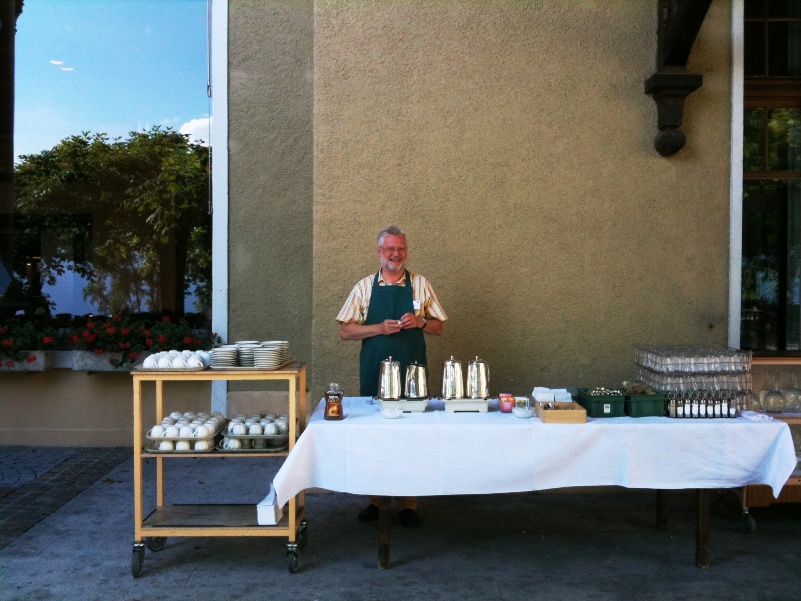
This place wasn’t just a hotel, it was a palace hotel (& during the Belle Époque, not Edwardian era – I’m learning). We all take turns with cooking and cleaning chores which helps jumble us up.
Today I had breakfast with Claire from the CEJI course and a Russian sociology student who has a passion for cooking. We discussed chicken-in-oven dishes: she puts the potatoes (a staple in her part of Russia) in with the chicken from the start and has tried a rice stuffing.
At lunch I chatted to someone based in Geneva who is involved in group conflict mediation both here and in Guatamala.
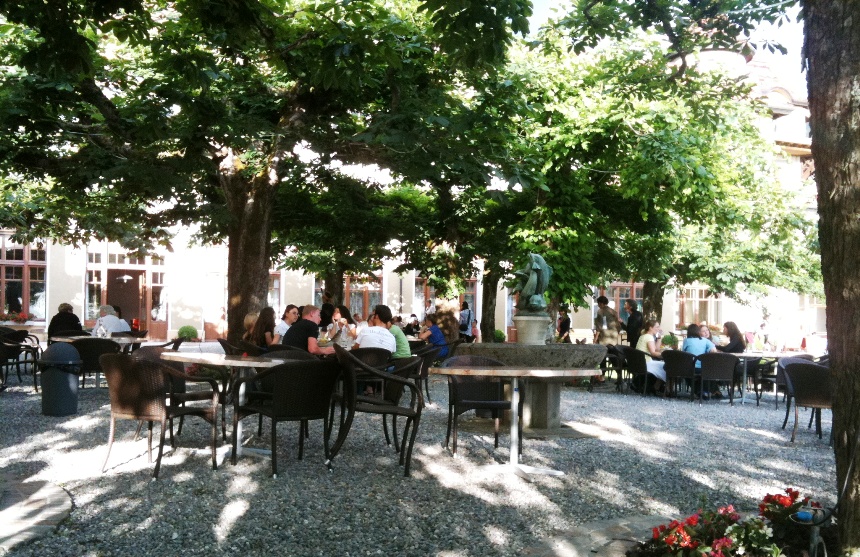
At supper I sat next to a Hungarian studying in the USA with strong views on the importance of civil society – positive social capital, trust between neighbours & colleagues, youth groups, sport, artistic communities, etc.
This is not evident, he says, in Hungary at the moment – people tend to be scrabbling for themselves and don’t see the point in coming together to start up, say, a youth club or athletics team. I think he was saying that in Hungary the individual’s responsibility is to earn money and the government’s job is to do anything else which is necessary – education, health care, etc.
He reckons globalisation hasn’t worked in favour of post-communist European countries. Combined with a poor economic outlook, lots of young people are trying to leave the country – often Germany, the UK or the US. Interesting contrast with the Broken Britain/Big Society we’ve been hearing about recently and the drive for social cohesion and local involvement. I suggested he get in touch with the New Economics Foundation. I wish there was a better term for ‘civil society’ – too much like ‘civil service’ and being coldly polite. ‘Third sector’ isn’t much of an improvement. Ordinary people don’t use these words and don’t think of themselves as part of a sector or civil society, even if they are.

A couple of excellent women on form this morning: Annemarie Sancar from the Swiss Agency for Development & Cooperation and Samia Allalou who is a journalist, activist and member of the ‘Women Living under Muslim Laws’ solidarity network in France & Algeria. Annemarie was scathing of what she saw as a simplified public conversation about women’s rights in Europe – in particular of Muslim women’s rights, often reduced to either/or groups –
- natives v immigrants
- emancipated v oppressed
- black v white
- modern v traditional
– when the reality is a lot more complex. Women with less power are more vulnerable to labelling, less able to challenge it. She didn’t have much time for western feminists who want to free oppressed migrant women by charging in like Crusaders to ‘rip up their cultures on the operating table’. The focus on headscarves detracts from important economic and political issues, with assumptions that they represent the oppression of women by men – this is not her experience (neither is it mine) and waging war on a piece of clothing, she said, does not make you a human rights activist. Behind each scarf is a life story, and, as importantly, behind every criticism of a headscarf is a life story, too. Being told to stop wearing a scarf by feminists or governments can feel pretty much like patriarchy.
I missed a very good workshop on LGBT immigration within global diversity – will have to catch up on papers. It’s fascinating living with people from so many different places – just like south London! My internet connection was set up by a young man from Mombasa.
Tomorrow tackles ‘Europe – the Fortress’ before settling down to the World Cup match – plenty of intercultural material there, too.



 Catriona Robertson
6 responses to “Civil society in Hungary, headscarf bans in Europe”
[…] only caught the last couple of days this year but it was well worth […]
LikeLike
[…] to Bosnia and Brussels last year (and to Switzerland, Austria, Czech Republic and Germany this year) have encouraged me to try to develop an informal […]
LikeLike
[…] Nina from Switzerland, who are over in London for few days and who put together the conference on multi-cultural Europe recently. We got together with a couple of other Londoners who had attended the CEJI training to […]
LikeLike
[…] tend to house their poorer residents on the outskirts. ‘Banlieues’ seemed (at the Caux event) to be shorthand for ‘inner city’, whereas the outskirts or suburbs of London tend to […]
LikeLike
[…] could have returned to London straight after the conference at Caux in Switzerland, but who could resist an international inter-rail timetable which included Vienna, […]
LikeLike
[…] you read German, the paper by Annemarie Sancar at Caux is now posted on the conference’s website, and a podcast interview in French. […]
LikeLike